Miniterio de Obras Publicas (MOSP) Pavilion
Buenos Aires, Argentina
1966
Gandelsonas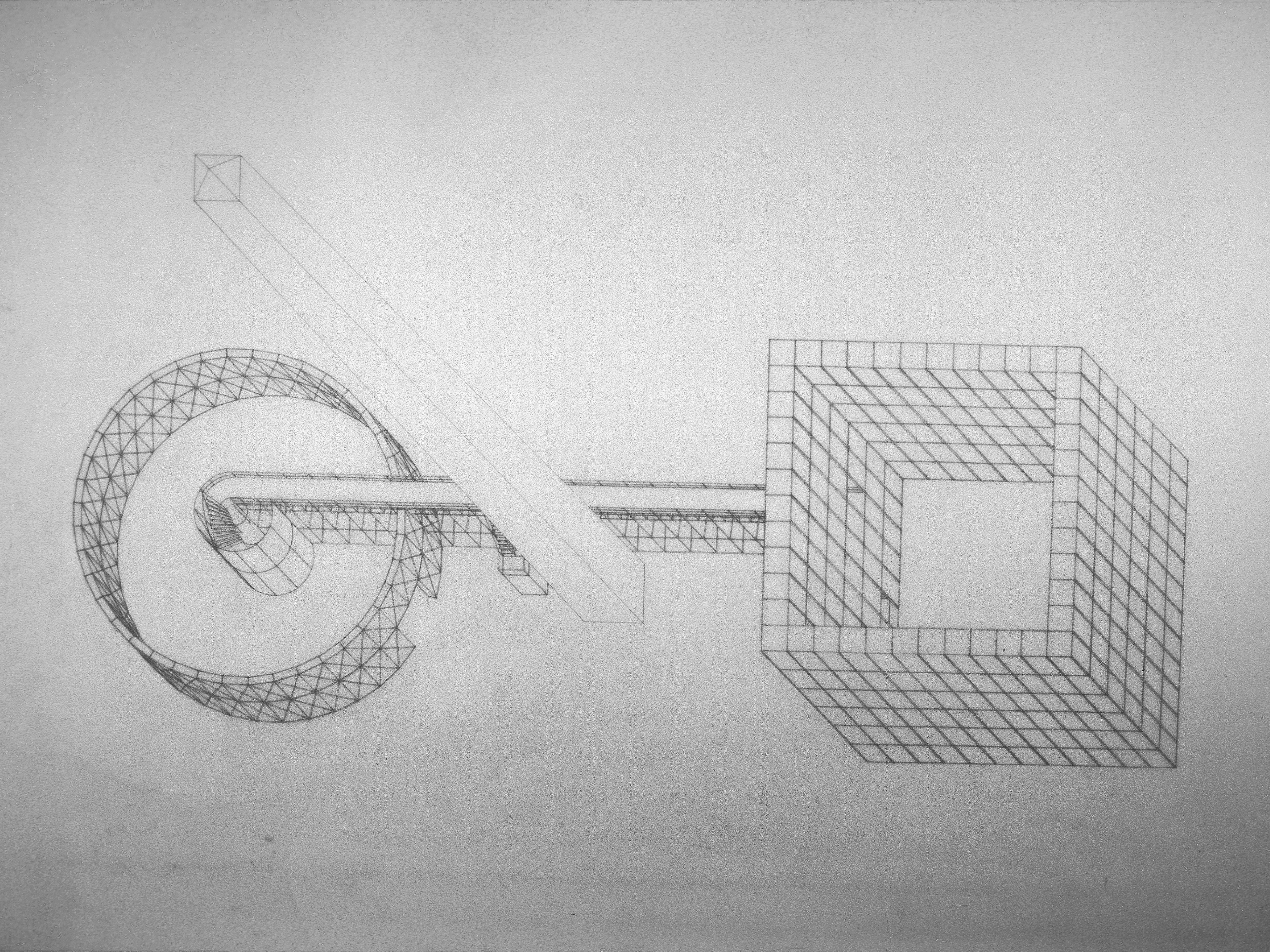
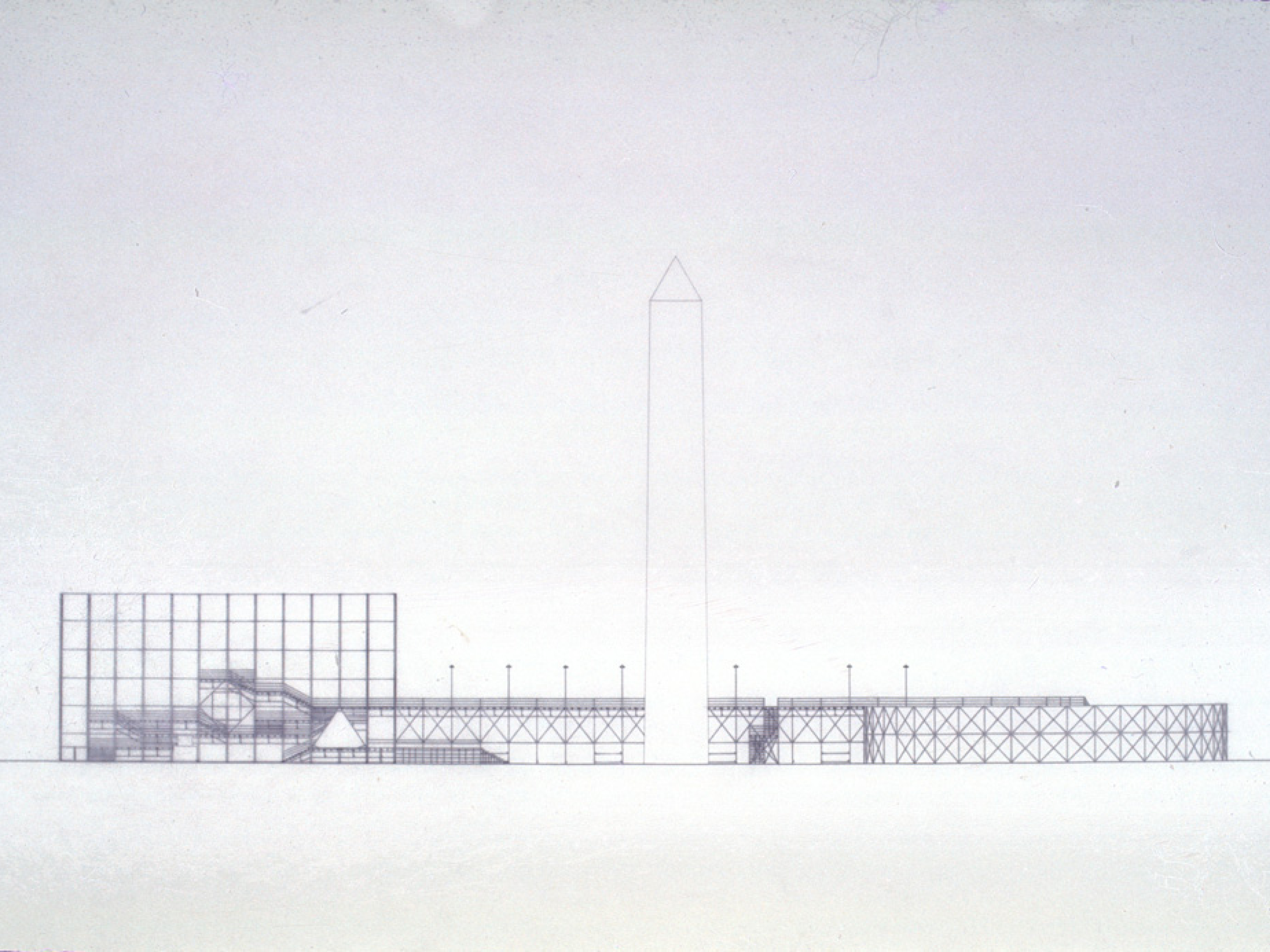


The MOSP Exhibition Pavilion, a temporary exhibition in Plaza de la Republica, Buenos Aires, was housed in two scaffolding structures on each side of the Plaza, an implied “cube” and a “cylinder” linked by a bridge. The exhibition was conceived as a sequence starting in a mirrored room with a triangular section that produced the image of an hexagonal section as a spectacular break with the reality of the urban public place and into a “spatial” trajectory that developed in plan and section. The cube, a three-dimensional scaffolding “thick wall” with canvas weaved through the structure, housed a spiraling sequence that ended up at the level of the bridge linking the cube to the cylindrical structure located at the other side of the Plaza where people descended a very wide spiraling stair to view a photographic exhibit of recent Public Works before exiting the exhibition.
“Arquitectura Argentina, 1960–70,” Francisco Bullrich
SUMMA 19, Octubre 1969, pp. 48–49
...The dictum “form follows function” has indeed been subjected to criticism. This does not imply that all interdependence has been abolished. It is thought that the theory of functionalism, in its simplified version, does not explain the true design process and that it is of little or no practical help when the architect has to deal with the multifunctionality of spaces or forms, which is, almost always, the case. In fact, an architect does not deduce an architectural image from an organizational chart. The design, on the contrary, arises from an image, and the analysis and confrontation with the requirements and subsequent adjustments will demonstrate its viability. If a satisfactory adjustment is not possible, there will be no choice but to find another starting point.
This simple fact..., which is considered by some to be unscientific and artisanal, but it is not clear how it could be modified. Thus, form turns out to be the starting point. This might seem to contradict so many statements that anathematize formalism, leaving one feeling lost. But the truth is that there is no real contradiction. What is fundamentally meant is not that form is unimportant but that it must be conceived in a new context. This makes us think that the direct attitude is not the product of pure spontaneity ex nihilo and that behind it lies a very elaborate self-awareness and theoretical development. A demonstration of this was the exhibition stand of the Ministry of Public Works and Services temporarily erected in Plaza de la Republica in 1965. The purpose of the team that programmed and developed the design of the stand, designed by the architect Mario Gandelsonas, was not so much to show “the works done by such a government” but to make people understand the value of public works and services as equipment constituting a network of social activities.
Integrated into everyday redundancy, public works and services are taken for granted as always being there and forever. The only way to draw attention was to present them in a new context where the poetics of a new significant organization would give them a new meaning. The stand thus became a communication agent, assuming the role of the sender (a ministry as a collective action body with minimal explicit reference to itself)...of a message (spatially and communicatively unusual)...for a receiver (the user turned spectator-judge), ...offering the possibility of continuous reinterpretation of the message from a series of inclusive perspectives, developing a chain of messages and enveloping it at the same time.
“Arquitectura Argentina, 1960–70,” Francisco Bullrich
SUMMA 19, Octubre 1969, pp. 48–49
...The dictum “form follows function” has indeed been subjected to criticism. This does not imply that all interdependence has been abolished. It is thought that the theory of functionalism, in its simplified version, does not explain the true design process and that it is of little or no practical help when the architect has to deal with the multifunctionality of spaces or forms, which is, almost always, the case. In fact, an architect does not deduce an architectural image from an organizational chart. The design, on the contrary, arises from an image, and the analysis and confrontation with the requirements and subsequent adjustments will demonstrate its viability. If a satisfactory adjustment is not possible, there will be no choice but to find another starting point.
This simple fact..., which is considered by some to be unscientific and artisanal, but it is not clear how it could be modified. Thus, form turns out to be the starting point. This might seem to contradict so many statements that anathematize formalism, leaving one feeling lost. But the truth is that there is no real contradiction. What is fundamentally meant is not that form is unimportant but that it must be conceived in a new context. This makes us think that the direct attitude is not the product of pure spontaneity ex nihilo and that behind it lies a very elaborate self-awareness and theoretical development. A demonstration of this was the exhibition stand of the Ministry of Public Works and Services temporarily erected in Plaza de la Republica in 1965. The purpose of the team that programmed and developed the design of the stand, designed by the architect Mario Gandelsonas, was not so much to show “the works done by such a government” but to make people understand the value of public works and services as equipment constituting a network of social activities.
Integrated into everyday redundancy, public works and services are taken for granted as always being there and forever. The only way to draw attention was to present them in a new context where the poetics of a new significant organization would give them a new meaning. The stand thus became a communication agent, assuming the role of the sender (a ministry as a collective action body with minimal explicit reference to itself)...of a message (spatially and communicatively unusual)...for a receiver (the user turned spectator-judge), ...offering the possibility of continuous reinterpretation of the message from a series of inclusive perspectives, developing a chain of messages and enveloping it at the same time.